

// Data
Data platforms: Databricks, Snowflake and pipelines you can audit
A board report calculated in a spreadsheet, a pipeline nobody dares to touch and a cloud bill nobody can split by team. We build and migrate platforms so that tests, permissions and lineage are part of the pipeline from day one.
- Databricks
- Snowflake
- dbt
- Airflow
- Prefect
- Azure
- AWS
- SQL Server
// In short
A data platform that produces its own evidence
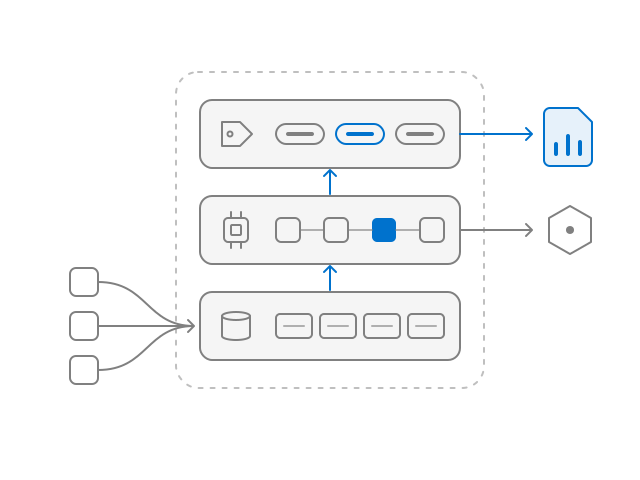
We design, build and migrate data platforms on Databricks, Snowflake, Azure, AWS and SQL Server, with pipelines in dbt, Airflow or Prefect. Every pipeline has data quality tests, access control, lineage and audit logs. For data, IT and finance teams that need numbers the board, the auditor and the AI model can trust.
// What we do
Build, migrate and keep costs under control
Auditors ask who accessed which data and when. In Poland, the KSC Act (NIS2 in Poland) even counts automatically generated system logs as operational documentation (Article 10(4), Dz.U. 2026 item 252, as of 24 September 2026). That is why we build logs and lineage together with the pipeline.
01Architecture
Platform design and build
A target architecture on Databricks or Snowflake, in Azure or AWS, with SQL Server where it stays.
- Target architecture sketch
- Data layers and naming conventions
- Infrastructure as code
02Migration
Migration slice by slice
One working slice first, then the next, with results compared before each cutover.
- Migration to Unity Catalog
- Pipelines moved off SQL Server and scripts
- Old and new pipelines running side by side
03Quality and evidence
Pipelines you can audit
Tests, permissions, lineage and logs are part of the pipeline, not documentation written after the fact.
- Data quality tests in dbt
- CI/CD for data
- Access control and audit logs
- Lineage from source to report
04Cost
A cloud bill you can explain
You know which pipeline and which team generates the cost, and what can be switched off.
- Costs allocated to teams and pipelines
- Cluster and warehouse sizes matched to the workload
- Schedules instead of always-on resources
First step: one pipeline from source to report in 6 weeks
Target architecture and cost model
One page of decisions: platform, data layers, orchestration and a cloud cost estimate.
A production-grade pipeline
One pipeline from the source system to the report, with quality tests, lineage and an access model based on who actually needs the data.
Backlog for the next pipelines
Prioritized work with dependencies, ready for your team or ours.
The result: a pipeline in production that carries its own evidence (tests, logs and lineage)
Fixed scope and date, agreed in writing before we start. Request the first step
// Scope
What we do, and what we don't
We do
- Design, build and migration of data platforms
- Pipelines in dbt, Airflow or Prefect, with tests and CI/CD
- Migration to Unity Catalog
- Work alongside your team, with knowledge transfer
We don't
- Reselling licenses and tools
- Migrating everything at once without a first working slice
- Reports on data whose origin nobody can trace
Our experience with these platforms comes from project work, not from partner programs. We earn nothing from licenses, so our advice does not depend on the vendor.
// Read more
Related topics and services
On our blog we write about what surrounds the platform:


// FAQ
Questions about data platforms
Databricks or Snowflake?
It depends on the main workload. Databricks fits better when there is a lot of Python and Spark processing, machine learning and unstructured data. Snowflake wins on simplicity for a SQL warehouse and reporting. We compare both on your pipeline and your costs before you buy anything.
What does a Unity Catalog migration look like?
First an inventory: workspaces, tables in the Hive metastore, permissions and jobs. Then we migrate one area at a time and compare results before switching over. Along the way we turn on the lineage and audit logs that Unity Catalog keeps at catalog level.
Do you work with our team?
Yes, and we prefer it. We work in your repository and to your standards, review code together with your team, and the documentation stays with you. If you need a data engineer for longer, see security and data specialists for your team.
How do you price this?
We quote our work before we start: the fixed scope and date of the first step are in writing. We estimate the cloud cost in the architecture sketch and measure it from the first pipeline, split by team and pipeline.
Can you take over existing pipelines?
Yes. We start with a review: what works, what nobody understands and where tests are missing. Then we move or fix pipelines one by one, with tests and a comparison of results.
Let's start with one pipeline
Point us to the report or data feed that causes the most trouble today. We reply within one business day, with questions about sources and scope.
Request the first stepPrefer to talk first?
30 minutes about your platform with the person who will run the project.
Book a 30-minute call (opens in a new tab)