
Apps accompany millions of users on a daily basis. Both those available to the public and those operating within a specific organization should be easy to use and created to meet user needs and system requirements. That is why it is so important to adapt the right technology. Already at the requirements analysis stage, we should know the answer to the question of whether it will be better to design applications natively or cross-platform. What to pay attention to in order to choose well? We explain.
Read More: 6 upcoming trends in app development
Native vs. Cross-Platform Development
When deciding on an approach for application development, one of the most crucial considerations is choosing between native vs. cross-platform development. This decision can significantly impact everything from the app’s performance to the overall user experience.
Code Reusability
Native development requires separate codebases for each platform, meaning that code reusability is minimal. However, code reusability is one of the standout advantages of cross-platform development, as developers can use a single codebase across multiple platforms in such app developments.
Application Performance
Native apps are tailored specifically to the platform they run on, allowing them to take full advantage of the device’s hardware and software capabilities. This typically results in faster load times, smoother animations, and a more responsive experience. Cross-platform apps tend to lag slightly behind native apps, particularly in more complex applications where performance is critical. However, it can offer an improved performance with advanced frameworks.
Development Time
When it comes to development time, cross-platform development shines brighter. By using a single codebase, developers can simultaneously create apps for multiple platforms, significantly reducing the time required to launch. On the other hand, while native apps often deliver superior performance, they can also take longer because each platform requires its own development process.
Development and Maintenance Cost
Native apps development tends to be more expensive regarding development and maintenance, as it often requires separate teams or specialized developers for each platform. Cross-platform development, on the contrary, usually costs less because a single team can handle the entire project, and changes can be applied across all platforms simultaneously.
Time to Market
If you want faster deployment across multiple platforms, cross-platform development can be a better choice. It has many advantages, including faster time to market. Native development, while potentially offering a better product in the end, usually takes longer, which can delay market entry.
Security
When considering security, native apps typically offer better protection because they are built specifically for a single platform. Developers can integrate platform-specific security features more effectively for such apps. Cross-platform apps might not offer the same level of security due to the limitations of a shared codebase. Yet, they might not be entirely unsafe.
Accessibility and Visibility
Native apps have full access to platform-specific APIs and features, which can enhance user accessibility and improve app visibility. However, cross-platform apps may not fully leverage these platform-specific features, which could impact both user experience and app discoverability.
User Experience
If you want something that offers a highly polished performance and improved user experience, native apps can be a go-to option. It ensures smooth navigation, faster response times, and better integration with the device’s operating system. Though cross-platform apps are capable of providing a good user experience, sometimes they fail to deliver the same level of polish and platform-specific performance. This ultimately has a negative effect on the user experience.
Availability of Developers
The availability of developers can influence your decision. While there is a large pool of developers skilled in native development for platforms like iOS and Android, finding developers proficient in cross-platform frameworks like React Native or Flutter is becoming increasingly easier.
Struggling to decide between native and cross-platform app development? Let Future Code help you make the right choice to maximize performance and user experience.
Web and mobile applications
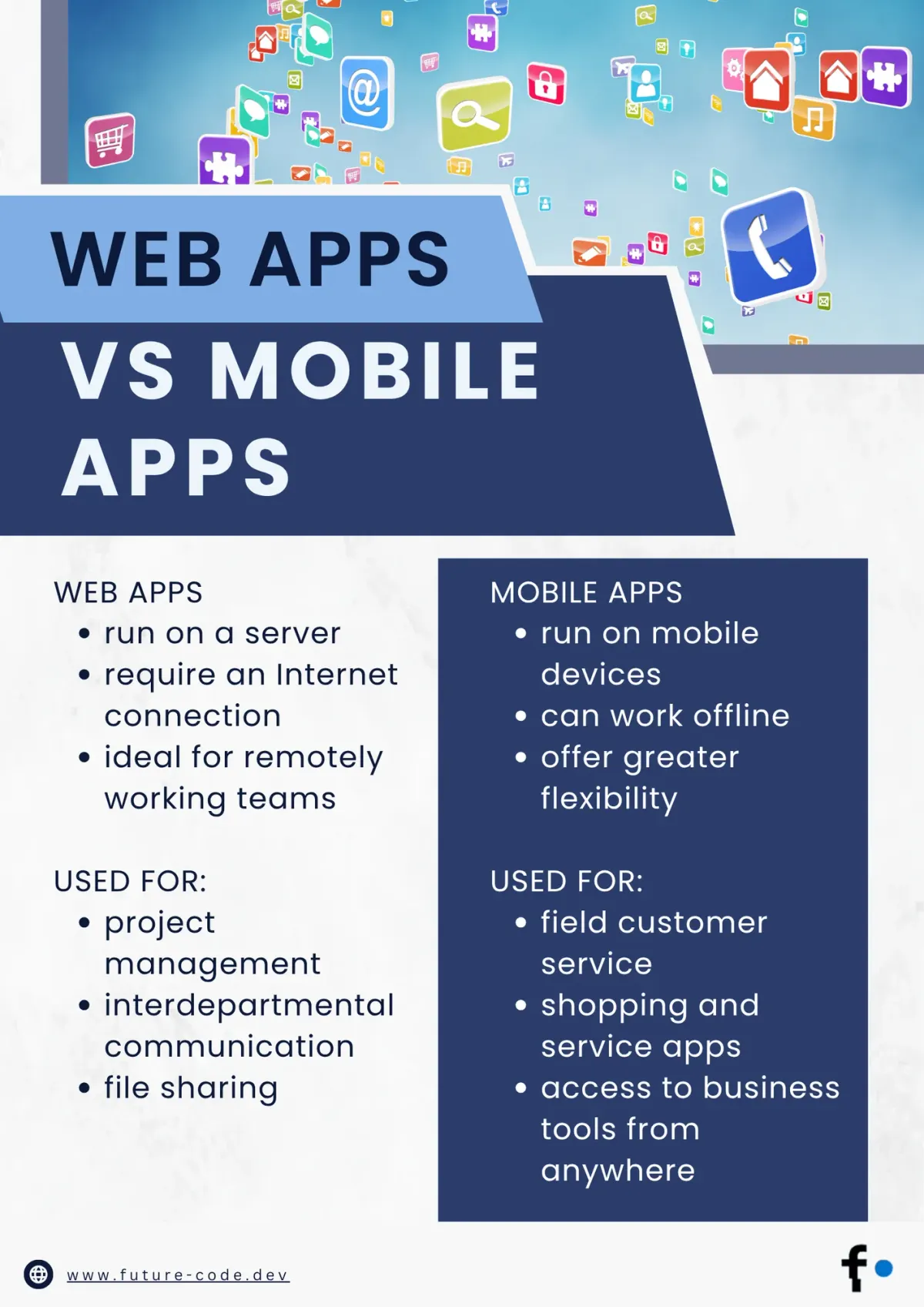
Web applications - unlike mobile ones - run on a server. A stable Internet connection is required for them to work properly. This is why web applications are so readily ordered by companies operating in industries where most teams work remotely. Web applications can be used to schedule work, communicate between departments or upload finished projects.
Mobile apps can run on a single platform (iOS or android, in which case we are talking about native apps) or hybrid mobile apps that run on both of the aforementioned platforms. In the second case, 70% of the code is shared, while 30% is in native form.
Native application design is generally done in Kotlin and Java languages for Android. iOS devices, on the other hand, usually implement code in Swift with Objective-C. If you choose to design mobile applications cross-platform, then frameworks such as React Native and Flutter are introduced.
Check out the detailed information on the offer: Software development
Before you start designing mobile apps
According to research posted on the Statista platform, as many as 218 billion mobile apps will be downloaded in 2020. Today, it could be close to 258 billion. The market is still not saturated, and the ever-increasing needs of users - not only business users - intensify the creativity of programmers and motivate many people to explore the secrets of the IT industry, especially the programming languages mentioned earlier.
Designing a mobile application that will be popular requires analyzing the idea and considering the extent to which the planned scope of work and functionality suits the target audience. It is on the basis of this type of data that you can plan your strategy, within which you should include:
- Potential customer expectations;
- How would your project address the needs of the target group?
- What could the potential costs be, and can the technology proposal answer them in a reasonably short time?
- What might be the cost of estimating the application?
The next step could be an Event Storming workshop - during which you can check how the application you have created works, visualize its capabilities and weaknesses. In addition, you will verify your previous assumptions about each stage of the application design.
Once you have collected the necessary data, it is a good idea to hold a kick-off meeting, where you can get to know the entire project team, set the rules of work and communication, and schedule preliminary dates for delivering and discussing the next parts of the project.
It’s important that you and your team think carefully about the visual and functional layout, or user experience (UX) design, which is just as important in web applications as it is in mobile ones. The intuitiveness we mentioned earlier should not remain an empty platitude. You can bet on dedicated design and custom design of mobile or web applications in terms of visuals, or try to adapt an already available, ready-made design.
Moving on to the penultimate stage of mobile and web application design, it is important to note the utility of the Agile method. Agile development for apps can accompany you and the entire team from the very beginning. It allows you to divide application development into cycles, made up of smaller parts. Usually the so-called. The sprints take the team approx. 2 weeks.
At almost every stage, testing of the application should be carried out before it is deployed. It is then possible to eliminate the maximum number of potential errors.
In the case of web applications, equal importance is given to the elimination of potential errors, as well as the realization of the concept of “usability” through app usability testing, which must be adequate to the created service.
Struggling to decide between native and cross-platform app development? Let Future Code help you make the right choice to maximize performance and user experience.
Does native application design provide a competitive advantage?
Platform-specific development is characterized by high performance and exceptional user experience, as the interface is tailored to the functionality and type of application.
Besides, various APIs greatly speed up potential development work, integrating many features that extend the capabilities of a mobile application. This, in turn, makes it more attractive to a potential user.
Despite the relatively high cost of developing these types of applications, they are among the more popular - they are more popular than the previously mentioned hybrid or web applications.
Also check out other articles on similar topics:
Mobile application development: Android and iOS
Why is cross-platform mobile app design a step into the future?
Multiplatform applications do not require a very complex development process. Besides, thanks to the common code, the updating process is very smooth. In addition, developers can implement API integration, confident that they will work on any platform. This allows you to reduce the time to get the finished product. With just one code created, the app will work on the device regardless of the platform.
Cross-platform mobile app design will also not limit the reach of the audience – as is the case with native apps. Importantly, cross-platform frameworks also provide an advantage in app performance optimization.
When is it a good idea to opt for cross-platform application design?
When you choose to design applications cross-platform, you get products that are easy to maintain and won’t fail even in the event of a sudden increase in the number of their users. Using Flutter or React Native, they can implement mobile app maintenance relatively quickly – a good solution for news sites, for example. Here is more on React Native vs. Flutter.
Flutter is Google's technology for programming applications not only for Android and iOS, but also websites and Windows, macOS and GNU/Linux operating systems. A single source code base is enough to create a fully functional multi-platform application. The code is written in this case in the Dart language.
React Native, on the other hand, is a framework by Facebook. Multi-platform applications are developed in JavaScript. For users, the differences may not be noticeable. However, it is worth noting Flutter’s advantage in terms of performance and compatibility. It is also effective for cost-effective app development.
We hope that through our article it will be a little easier to plan the process of developing a mobile application and possible modifications or proposing certain solutions to customers. We invite you to read our other articles.
Struggling to decide between native and cross-platform app development? Let Future Code help you make the right choice to maximize performance and user experience.