Cybercrime has been one of the most threatening problems in the digital world, and it is becoming more common despite many efforts to detect threats and reduce personal data breaches. However, despite these efforts, the global cybercrime cost is expected to reach USD 10.5 trillion by 2025. That is why it is vital to prioritize the highest form of security in protecting digital assets.
Implementing AI plugins for cybersecurity is one such form of protection against such attacks. These plugins detect threats and use AI and (ML) algorithms to prevent suspicious activities in real-time. Since AI can comb through a large amount of data several times faster than humans, it can improve security systems way better than traditional security methods.
Read More: Tips On How To Take Care Of Web Application Security
The Basics of AI in Cybersecurity
The use of Artificial Intelligence (AI) technology, such as Machine Learning (ML) and Natural Language Processing (NLP), to ensure protection against cyber attacks is known as AI Security Solutions. Though the use of AI began in the late 1900s and early 2000s, it did not gain worldwide adoption until several years later.
Traditional cybersecurity tools, such as antivirus software, can only detect known threat patterns. On the contrary, using AI or machine learning in cybersecurity can protect vast amounts of data and identify a broader range of threats and attacks. Moreover, it automates threat responses, protects data in real-time, and blocks suspicious activities.
AI plugins work by integrating a connection between the AI agent and the existing system. This system can analyze the device’s behavior and detect threats in real time. Moreover, these plugins can automate repetitive routine tasks, such as scanning vulnerabilities, responding to common threats, reducing human tasks and errors, etc. The AI plugins leverage ML algorithms to analyze existing data and the system’s behavioral patterns to predict upcoming threats and attacks to ensure better cybersecurity.
Ready to fortify your defenses with cutting-edge AI technology? Future Code's AI plugins provide advanced protection, real-time threat detection, and automated responses to keep your business secure.
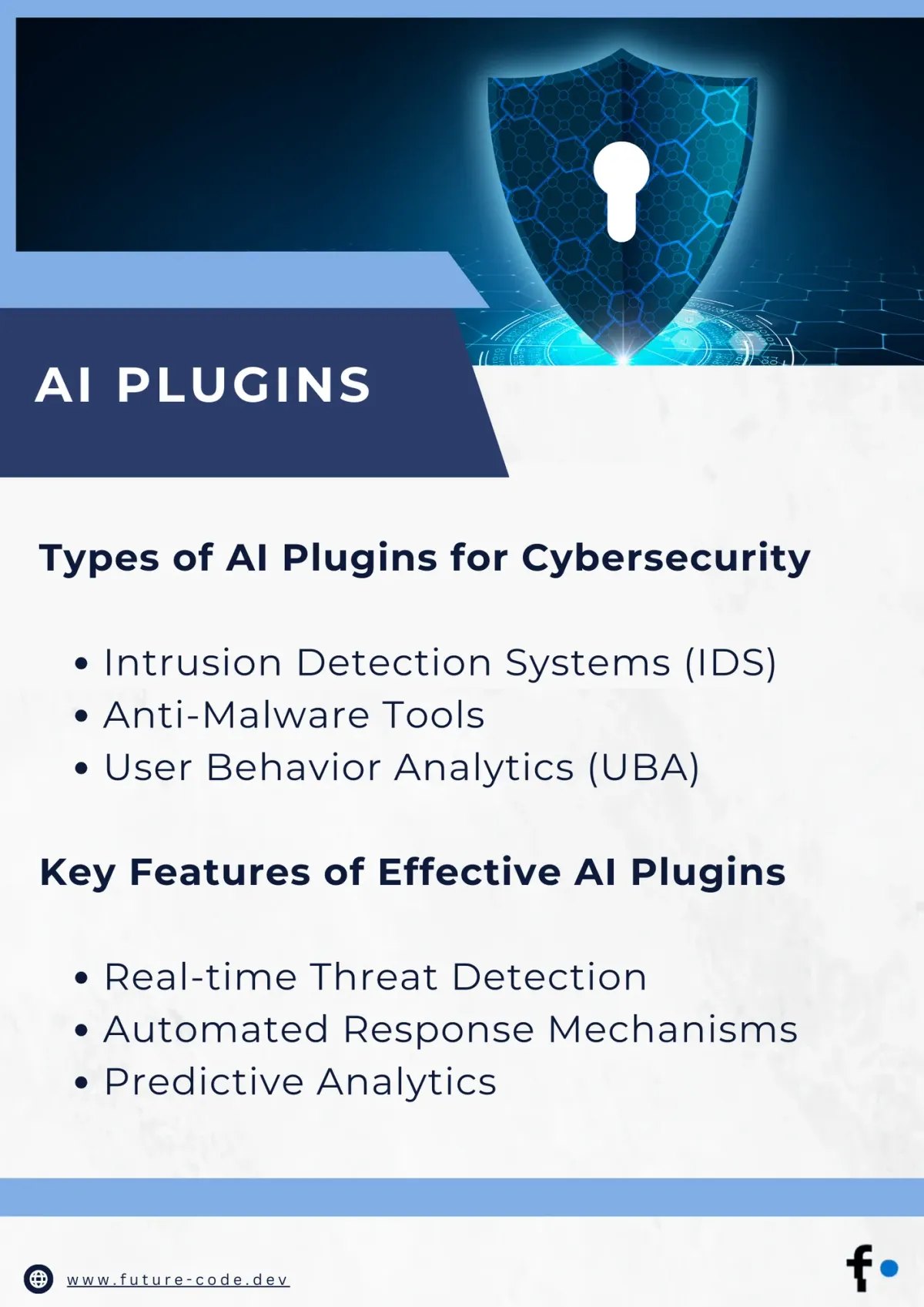
Types of AI Plugins for Cybersecurity
Intrusion Detection Systems (IDS)
Intrusion Detection Systems (IDS) is an app that monitors network traffic to detect suspicious activities and known threats. The plugins analyze the data to identify unusual patterns and send alerts to the IT security team in real-time if they detect any threat. Since IDS can distinguish between normal and suspicious behaviors, it prioritizes threats and enhances response time.
Anti-Malware Tools
Anti-malware software can be highly beneficial for additional protection against viruses and threats. This type of software uses a set of archived malware signatures (blacklist) to scan for viruses in a device. The software compares the detected suspicious files to the ones in its blacklist to flag them as a threat. Using automatic update features, the anti-malware software detects the newest threats. Another way to implement threat detection is by implementing Heuristic analysis, which can detect unknown or modified versions of existing threats. Using behavior-based detection is another effective way to implement protection against advanced threats, such as fileless malware, zero-day malware, ransomware, etc.
User Behavior Analytics (UBA)
User Behavior Analytics (UBA) is a tool for monitoring and analyzing user actions and behavioral patterns. It detects and responds to threats using user accounts if it detends abnormal behaviors. The main feature of UBA lies in its ability to predict potential or insider threats before they can cause any serious harm.
Key Features of Effective AI Plugins
Real-time Threat Detection
Effective AI-powered security plugins can be achieved by continuous monitoring for real-time threat detection, such as network traffic, endpoint activities, logs, etc. This will allow the security system to send instant alerts if there are any bandwidth spikes, network anomalies, unusual traffic patterns, etc. The advantage of enabling such alerts is that it helps reduce response time and enhance overall security posture.
Automated Response Mechanisms
Cybersecurity automation with self-healing systems can easily detect and diagnose problems and repair them without any kind of human intervention. The automated system isolates the threat immediately to prevent further spreading and minimize damage.
Predictive Analytics
Predictive analytics is vital for optimizing business operations. It analyzes historical data to streamline workflow, reduce costs, and allocate resources. Based on the analytic data, the system helps forecast future attacks and ensures digital asset protection. As predictive analytics offer insights into the security system, it makes it easier to implement proactive threat management. It also enhances preparedness by improving security measures and reactivating security postures.
Implementing AI Plugins in Your Cybersecurity Strategy
Assessing Your Needs
The most effective way to implement AI plugins in your cybersecurity strategy requires a few steps. The first step involves assessing your needs. Start by evaluating your current security systems to find their strengths and weaknesses and whether they meet the latest security measurements. Look for vulnerabilities or any kind of weakness that may be exploited by cyber threats. You must prioritize assets while implementing AI in cyber defense to ensure that important assets remain protected in all conditions.
Choosing the Right Plugins
Next, you need to carefully consider when choosing the right plugins for implementing AI for data protection. The most important thing to consider is whether the plugin is compatible with your existing system to maximize performance efficiency. Also, you must consider the vendor's reputation by checking their history and information regarding their work, as the most reputed vendors tend to be more reliable in the industry. Another way to choose the best plugins is by checking user reviews because they will educate you regarding the plugin or vendor’s pros and cons. Finally, you need to consider the cost factors, such as prices, areas they cover, upgrade costs, benefits, long-term plans, etc.
Integration and Deployment
Once you have chosen the best and most suitable AI plugin, you have a few more things to do regarding its installation and deployment. Follow the instructions or step-by-step guide provided by the vendor for the right setup. Then, you need to align your business’s system to the plugin’s configuration settings by adjusting the necessary parameters. You can test the plugin’s functionality by stimulating various threats and see their performance or effectiveness. Make sure to monitor the plugin continuously by assessing and updating it from time to time to check for AI-driven threat detection.
Ready to fortify your defenses with cutting-edge AI technology? Future Code's AI plugins provide advanced protection, real-time threat detection, and automated responses to keep your business secure.
Challenges and Limitations of AI Plugins
False Positives and Negatives
AI plugin implementation also faces various challenges and limitations. The most common ones are false positives and negatives. In case you don’t know what that is, here is an example. AI detection tools often flag human-written articles as AI content, which is a false positive. On the other hand, if AI-written content is passed as a human-written article by such a tool, it is called a false negative. Similarly, the security plugins often flag down real users' activities as threats when the real threats often go undetected, impacting the entire operation and security system.
However, these problems can be reduced by enhancing AI in cyber risk management and improving the accuracy of the system. It can also help balance sensitivity and maintain efficient cybersecurity operations.
Resource Requirements
AI plugin implementation requires specific hardware and software that meet the necessary requirements based on your system. If not, it can easily impact the overall system and slow down the performance. The cost of AI plugin implication is yet another challenge because businesses must consider hardware costs, software costs, system installation, maintenance costs, etc. The system should be able to adapt to the increased workload and complexity as the business expands.
Ethical and Privacy Concerns
The use of AI in cybersecurity also raises various ethical questions. AI is known to be biased due to biased data collection processes from internal and external sources. Protecting users' login data and personal information can easily be breached due to unethical AI practices. However, the risk can be prevented or minimized by conducting regulatory compliance. It involves scanning and monitoring the database, enforcing ethical and lawful practices, following necessary guidelines, etc. It is also vital to maintain transparency in AI decisions to build trust.
The Future of AI in Cybersecurity
Emerging Technologies
The future of AI in cybersecurity is moving toward more autonomous technological advancement and digital resilience. For example, quantum computing can process and analyze vast amounts of data and offer more accurate predictions. With advanced machine learning and integration with IoT, plugins can detect threats more accurately. Using blockchain for security can enhance and secure data sharing and transferring.
Trends and Predictions
AI is expected to heavily impact the cybersecurity landscape in the near future. From basic and random viruses to vicious spyware and ransomware, the evolution of threats has changed a lot. The only way to resist them is by collaborating with AI cybersecurity tools, which are also evolving and becoming more capable to ensure better security. Enhanced AI capabilities make threat detection, prediction, and real-time responses quicker than expected.
Conclusion
AI plugins are vital for threat detection, managing system vulnerability, automated threat response, and, most importantly, enhancing data security. While using anti-malware tools and plugins can help take necessary precautions, the overall implication also comes with various challenges. However, the future of cybersecurity can witness dramatic change due to the use of more upgraded technology and applications. That is why it is vital to upgrade the system, monitor performance, and use the latest tools and software to navigate future challenges and foster a safe digital landscape.
Ready to fortify your defenses with cutting-edge AI technology? Future Code's AI plugins provide advanced protection, real-time threat detection, and automated responses to keep your business secure.